
EM Radiation Research Trust (RRT) response to the RNZ news feature
20 July 2026
On RNZ, a feature was published under the headline:
“There’s no evidence that mobile phones will give you brain cancer.” [1]
The feature reported on a newly published personal overview article, “Health risks of radiofrequency electromagnetic fields, and the World Health Organization’s programme,” by Mark Elwood and Ken Karipidis, published in the New Zealand Medical Journal on 17 July 2026. [2]
The headline and central message of the RNZ news feature has since been reproduced by media outlets around the world, potentially amplifying a categorical claim that is not supported by the body of scientific evidence.
It is important to distinguish between the RNZ feature, the Elwood–Karipidis personal overview article, and separate criticisms of the WHO review programme.
The Elwood–Karipidis paper is the new overview that RNZ reported on. It examines the findings of the WHO-sponsored systematic reviews of the health effects of radiofrequency electromagnetic fields. We understand that both Mark Elwood and Ken Karipidis have also been involved in the design and authorship of some of the WHO systematic reviews discussed in the paper.
Separately, the EM Radiation Research Trust has previously raised concerns about the WHO radiofrequency review programme. Our report highlights Microwave News reports and RRT letters sent to UK ministers that raise questions about the independence of the review process and the overlap between some scientists involved in the WHO reviews and the International Commission on Non-Ionizing Radiation Protection (ICNIRP). These concerns were reported in “WHO Radiofrequency Review Under Scrutiny Following New Investigation.” [3]
Those concerns provide important context when considering the WHO review programme and the conclusions drawn from its reviews. They are separate from the question of what the newly published Elwood–Karipidis paper actually says.
The Elwood–Karipidis overview is available online through the New Zealand Medical Journal. Readers can access it by registering for free. The paper itself is considerably more cautious than the RNZ news headline.
Its abstract acknowledges that the WHO-sponsored reviews found high-confidence evidence of increased glioma and heart schwannoma in male rats exposed to radiofrequency radiation. It also acknowledges that the relevance of these findings to humans remains a key issue.
The paper further acknowledges that the WHO review process and its results have been criticised. It also notes that many areas of evidence were assessed as low or very low confidence and that, in many cases, the available evidence may be insufficient both to demonstrate a risk and to rule one out.
Yet the RNZ news headline tells readers:
“There’s no evidence that mobile phones will give you brain cancer.”
The headline therefore makes a categorical claim that the underlying scientific literature does notjustify.
There is evidence.
It includes epidemiological findings from studies and analyses reporting increased risks in some exposure groups; high-confidence findings of increased glioma and heart schwannoma in male rats in the WHO’s own review of animal studies; findings from the US National Toxicology Program [4] and the Ramazzini Institute [5]; and the earlier evidence that led the International Agency for Research on Cancer (IARC) to classify radiofrequency electromagnetic fields as “possibly carcinogenic to humans” (Group 2B). [6]
The question is not whether relevant findings and evidence exist. They plainly do. The question is how that evidence should be interpreted, how much weight should be given to conflicting studies, whether methodological limitations have been applied consistently, and how animal findings should be extrapolated to humans.
That is a very different proposition from “there is no evidence.”
The issue of inconsistent standards matters
The problem is not that evidence should never be classified as “low” or “very low” confidence. The problem is whether those standards are being applied consistently.
The concern is that studies with serious methodological weaknesses that report reassuring or null results may nevertheless be treated as important evidence, while evidence pointing towards increased risk is downgraded.
The Danish mobile-phone cohort illustrates this concern. Its reliance on subscription status as a proxy for exposure, combined with the exclusion of corporate subscriptions, created the potential for substantial exposure misclassification. Despite these limitations, the study is often treated as reassuring evidence.
“Low quality” should not become a convenient label for making inconvenient findings disappear while methodologically problematic null results are treated as evidence of safety.
These and other methodological concerns have been examined in detail in the report, Cellphones and Brain Tumors: 15 Reasons for Concern – Science, Spin and the Truth Behind Interphone. It examined the large international Interphone study and identified methodological concerns that could have biased the results towards underestimating risk. [7]
The reported increase in England of the rapidly fatal brain tumour glioblastoma also cannot simply be ignored.
The authors reported that the increase was not adequately explained by changes in imaging, diagnosis, tumour classification or demographic factors.
Their analysis suggested that much of the increase may have been due to the promotion or transformation of previously non-lethal, low-grade brain tumours into highly aggressive glioblastoma multiforme (GBM) tumours. At the same time, the authors also identified an increase in newly initiated GBM tumours.
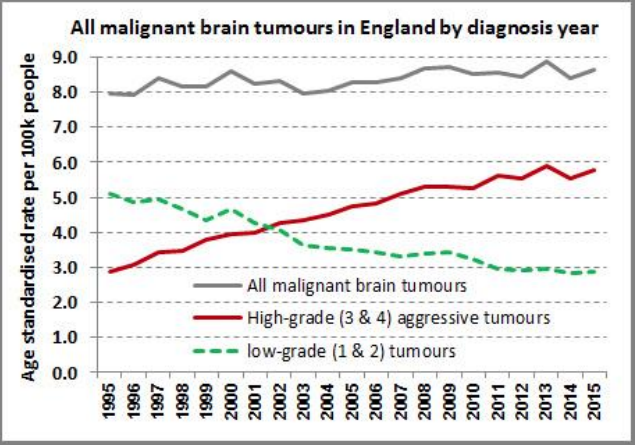
Figure 2 in:
Philips A, Henshaw DL. Lamburn L, O’Carroll MJ. 2018. Brian Tumours: Rise in Glioblastoma Multiforme Incidence in England 1995-2015 Suggests and Adverse Environmental or Lifestyle Factor. Journal of Environmental and Public Health. Volume 2018, Article ID 7910754, 10 pages. https@//doi.org/10.1155/2018/7910754
GBM is an extremely aggressive brain cancer, with patients commonly facing a median future life expectancy of only approximately 12 to 18 months following diagnosis.
A substantial increase in the incidence of a deadly brain tumour is therefore a finding that requires explanation. It cannot simply be ignored when making the categorical claim that there is “no evidence” of a possible relationship between radiofrequency exposure and brain cancer. [8]
The scientific debate has not been settled
The WHO-sponsored reviews have been directly criticised in the peer-reviewed literature.
In a 2025 paper published in Environmental Health, Ronald Melnick, Joel Moskowitz, Paul Héroux and colleagues, writing on behalf of the International Commission on the Biological Effects of Electromagnetic Fields (ICBE-EMF), published “The WHO-commissioned systematic reviews on health effects of radiofrequency radiation provide no assurance of safety.” [9]
Their paper argues that methodological weaknesses in the WHO-commissioned reviews mean that they cannot be regarded as establishing the safety of mobile phones and other wireless communication devices. The authors specifically identify concerns including the exclusion of relevant studies, weaknesses in some of the included primary studies, limited numbers of studies available for some meta-analyses, and substantial differences between the studies being combined.
Other researchers, including the highly respected Swedish oncologist and cancer epidemiologist Lennart Hardell and his colleagues, have reported increased risks of glioma associated with cumulative use of mobile and cordless phones, with risks increasing with longer latency periods and cumulative exposure. In their pooled analysis, the highest risks were found among those with more than 10 years of latency and among those first exposed before the age of 20. [10]
Hardell has argued that radiofrequency radiation should be re-evaluated by the World Health Organization’s International Agency for Research on Cancer (IARC) and upgraded from Group 2B (“possibly carcinogenic to humans”) to Group 1 (“carcinogenic to humans”).
In the Radiation Research Trust report 5G: The Untold Story, Hardell goes further, stating:
“My advice would be to dismantle 5G. It is a toxic agent that has been forced upon human beings.” [11]
Further evidence from population studies
A 2024 meta-analysis by South Korean researchers, published in the journal Environmental Health, reported associations between mobile-phone use and certain brain tumours, including glioma and meningioma. The analysis found higher risks associated with use on the same side of the head as the tumour. They also found that heavy, long-term cellphone use was linked to an increased risk of glioma. [12]
Increasing CNS tumour incidence in Denmark also warrants attention
A further analysis of Danish Cancer Registry data has reported an increase in the incidence of central nervous system (CNS) and brain tumours. The Swedish Radiation Protection Foundation examined reports from the Danish Cancer Registry covering the period from 1995 to 2023 and reported that CNS and brain tumours had increased, including among the cancer types showing the most rapid increase over the decade from 2014 to 2023.
The analysis was conducted by researchers associated with the Swedish Radiation Protection Foundation, who examined age-standardised incidence data from the Danish Cancer Registry.
An increasing incidence of CNS and brain tumours should not be dismissed when making categorical claims that there is “no evidence” of a possible risk.
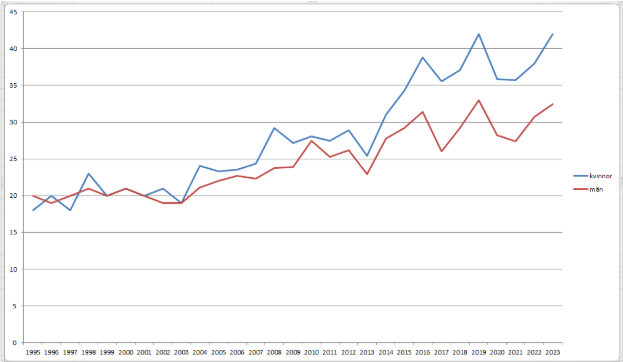
Source: Swedish Radiation Protection Foundation, based on data from three reports by the Danish Cancer Registry. [13]
These findings represent a substantially different interpretation of the epidemiological evidence from the reassuring conclusions presented in the RNZ news feature.
Legal proceedings and conflicts of interest
The evidence should also be considered alongside six court cases in which courts have accepted evidence of a link between occupational mobile-phone use and brain or head tumours. In the Italian case of Romeo v. INAIL, the Court of Appeal of Turin upheld a previous judgment finding that the worker’s acoustic neuroma was caused by his occupational use of a mobile phone. The court considered scientific evidence including epidemiological data, animal studies, the duration and intensity of exposure, and the dose-response relationship.
The Tribunal also considered conflicts of interest in the scientific literature. It noted that some studies rejecting a carcinogenic effect from radiofrequency exposure, or arguing that contrary research was inconclusive, involved researchers connected with the International Commission on Non-Ionizing Radiation Protection (ICNIRP) and/or the European Commission’s Scientific Committee on Emerging and Newly Identified Health Risks (SCENIHR). The Tribunal noted that these organisations had received funding, directly or indirectly, from industry.
The Tribunal stated:
“Much of the scientific literature that excludes carcinogenicity from RF exposure, or at least argues that research to the contrary cannot be considered conclusive… is in a position of conflict of interest, which is not always asserted…”
These legal proceedings demonstrate that the question of risks from prolonged mobile-phone exposure has been considered seriously in the courts and has not been uniformly dismissed. They provide further context for why the available evidence cannot simply be reduced to the categorical claim that there is “no evidence”. [14]
The danger of false reassurance
This is not an academic argument with no consequences.
When the public is told that there is “no evidence” that mobile phones can cause brain cancer, many people will understandably conclude that there is no reason for caution.
That message is dangerous.
There is evidence of potential harm. There are epidemiological findings that cannot simply be erased. There are serious methodological criticisms of studies commonly used to provide reassurance. There are animal studies reporting increased tumours, including findings that the WHO’s own review assessed with high confidence. And there is continuing disagreement over how the evidence should be evaluated.
People should be given the evidence, not a reassuring conclusion that goes beyond what the evidence can support.
No one wants to discover years from now that a potential risk was minimised because the evidence was inconvenient, uncertain or politically difficult.
No one wants to find themselves in the position described by Chris Woollams, one of the endorsers of the report Cellphone and Brain Tumors: 15 Reasons for Concern:
“In a world where a drug cannot be launched without proof that it is safe, where the use of herbs and natural compounds available to all since early Egyptian times are now questioned, their safety subjected to the deepest scrutiny, where a new food cannot be launched without prior approval, the idea that we can use mobile telephony, including masts, and introduce WiFi and mobile phones without restrictions around our 5 year olds is double-standards gone mad. I speak, not just as an editor and scientist that has looked in depth at all the research, but as a father that lost his beloved daughter to a brain tumour.” Chris Woollams M.A. Biochemistry (Oxon). Editor Integrated Cancer and Oncology News (icon magazine). CEO CANCERactive.
The question is whether the evidence justifies telling millions of people that there is “no evidence” of a possible risk.
It does not.
There is evidence.
There are findings that require urgent attention and explanation.
And there is enough uncertainty that categorical reassurance is not scientifically justified.
A newspaper report that converts that contested scientific question into “there is no evidence” is not merely simplifying the science.
It is changing the scientific claim.
And when that changed claim is used to reassure the public about a ubiquitous exposure affecting adults and children alike, the consequences of getting it wrong could be profound.
References
- RNZ. There’s no evidence that mobile phones will give you brain cancer.
Available online: https://www.rnz.co.nz/life/wellbeing/no-evidence-mobile-phones-cause-brain-cancer-new-study - Elwood JM, Karipidis K. Health risks of radiofrequency electromagnetic fields, and the World Health Organization’s programme. New Zealand Medical Journal. 2026;139(1638).
Available online: https://pubmed.ncbi.nlm.nih.gov/42462234/ - Radiation Research Trust. WHO Radiofrequency Review Under Scrutiny Following New Investigation.
Available online: https://radiationresearch.org/who-radiofrequency-review-under-scrutiny-following-new-investigation/ - US National Toxicology Program. Cell Phone Radio Frequency Radiation.
Available online: https://ntp.niehs.nih.gov/research/topics/cellphones - Falcioni L, et al. Report of final results regarding brain and heart tumors in Sprague-Dawley rats exposed from prenatal life until natural death to mobile-phone radiofrequency field representative of a 1.8 GHz GSM base station environmental emission. Environmental Research. 2018;165:496–503.
Available online: https://pubmed.ncbi.nlm.nih.gov/29530389/ - International Agency for Research on Cancer (IARC). IARC classifies radiofrequency electromagnetic fields as possibly carcinogenic to humans. IARC Press Release No. 208, 31 May 2011.
Available online: https://www.iarc.who.int/wp-content/uploads/2018/07/pr208_E.pdf - Radiation Research Trust / Powerwatch. Cellphones and Brain Tumors: 15 Reasons for Concern – Science, Spin and the Truth Behind Interphone.
Available online: https://www.powerwatch.org.uk/science/15reasons.asp?pf=0 - Philips A, Lamburn G, Henshaw DL, O’Carroll M. Incidence of deadly brain tumours in England doubled between 1995 and 2015.
Available online: https://www.powerwatch.org.uk/news/20180709-glioma-increase-paper.asp - Melnick RL, Moskowitz JM, Héroux P, et al. The WHO-commissioned systematic reviews on health effects of radiofrequency radiation provide no assurance of safety. Environmental Health. 2025;24(1):70.
Available online: https://pubmed.ncbi.nlm.nih.gov/41034851/ - Hardell L, Carlberg M, Hansson Mild K. Pooled analysis of case-control studies on malignant brain tumours and the use of mobile and cordless phones, including living and deceased subjects. International Journal of Oncology. 2011.
Available online: https://pubmed.ncbi.nlm.nih.gov/21331446/ - Radiation Research Trust, 5G: The Untold Story, premiered 11 June 2025. https://radiationresearch.org/5g-the-untold-story-premiered-11-june-2025/
- Moon J, Kwon J, Mun Y. Mobile phone use and brain tumours: a systematic review and meta-analysis. Environmental Health. 2024;23:93. doi:10.1186/s12940-024-01117-8 https://link.springer.com/article/10.1186/s12940-024-01117-8
- Swedish Radiation Protection Foundation. Increasing incidence of CNS tumours in Denmark. Based on data from three reports by the Danish Cancer Registry. https://radiationprotection.se/cancer/increasing-incidence-of-cns-tumours-in-denmark/
- Phonegate Alert. “The Court of Appeal of Turin confirms the link between a head tumour and mobile phone use.” 15 January 2020. https://phonegatealert.org/en/the-court-of-appeal-of-turin-confirms-the-link-between-a-head-tumour-and-mobile-phone-use/?ct=t(Y_COPY_01)
